The judgment you need to make here is very specific: you're preparing to buy a bracelet listed as [Cartier](https://fashion-reps.net/brand/cartier), and you want to know whether the QC photos can help verify the links, clasp, sizing, and surface condition, and then decide whether to approve, request more photos, or hold off. Key conclusion first: the specified photos available for verification correspond to a Hermès Matte Gray "H" Bracelet, not a Cartier bracelet. So they can only illustrate how
Editor score 4.2 / 5
The judgment you need to make here is very specific: you're preparing to buy a bracelet listed as Cartier, and you want to know whether the QC photos can help verify the links, clasp, sizing, and surface condition, and then decide whether to approve, request more photos, or hold off. Key conclusion first: the specified photos available for verification correspond to a Hermès Matte Gray "H" Bracelet, not a Cartier bracelet. So they can only illustrate how to read QC evidence; they cannot prove the authenticity, workmanship, or sizing of any Cartier item.⚠️
The Specific Purchase Decision This Cartier Bracelet QC Needs to Support
Start by separating the item's identity from the photos' identity. The product detail page, style name, variant, and QC photos must all belong to the same item; if the page title says Cartier but the photos show a Hermès H-shaped bangle, you cannot treat those photos as Cartier QC evidence.
After reviewing, you should be able to do three things: confirm whether the photos belong to the target item; record the visible facts; and if evidence is insufficient, pause confirmation and make specific requests for additional photos. This does not apply when: photos come from a different item, only category thumbnails are available, photos are too blurry, or no measurement reference is shown.
First Check the fashion-reps Product Page, Style, and Current Variant
The page data shows that the specified photos come from the Hermès Matte Gray "H" Bracelet listing on fashion-reps. The listing describes a matte gray or black H-shaped bangle, with a stated size range of 17–19 cm, and a listed reference price of $21.94; final item price, service fees, and international shipping must still be confirmed on your chosen shopping agent's site. Price, stock, variant, and fees are time-sensitive information that must be re-verified before ordering; you cannot infer the current quote from this guide.
The page data also shows that the listing provides an entry called View QC Photos. The correct verification order is: first confirm the product name and current variant on the detail page, then click View QC Photos within that listing, and finally view the original QC photos for that item. Do not substitute photos from the homepage, brand page, category page, or other items for the target item's photos.

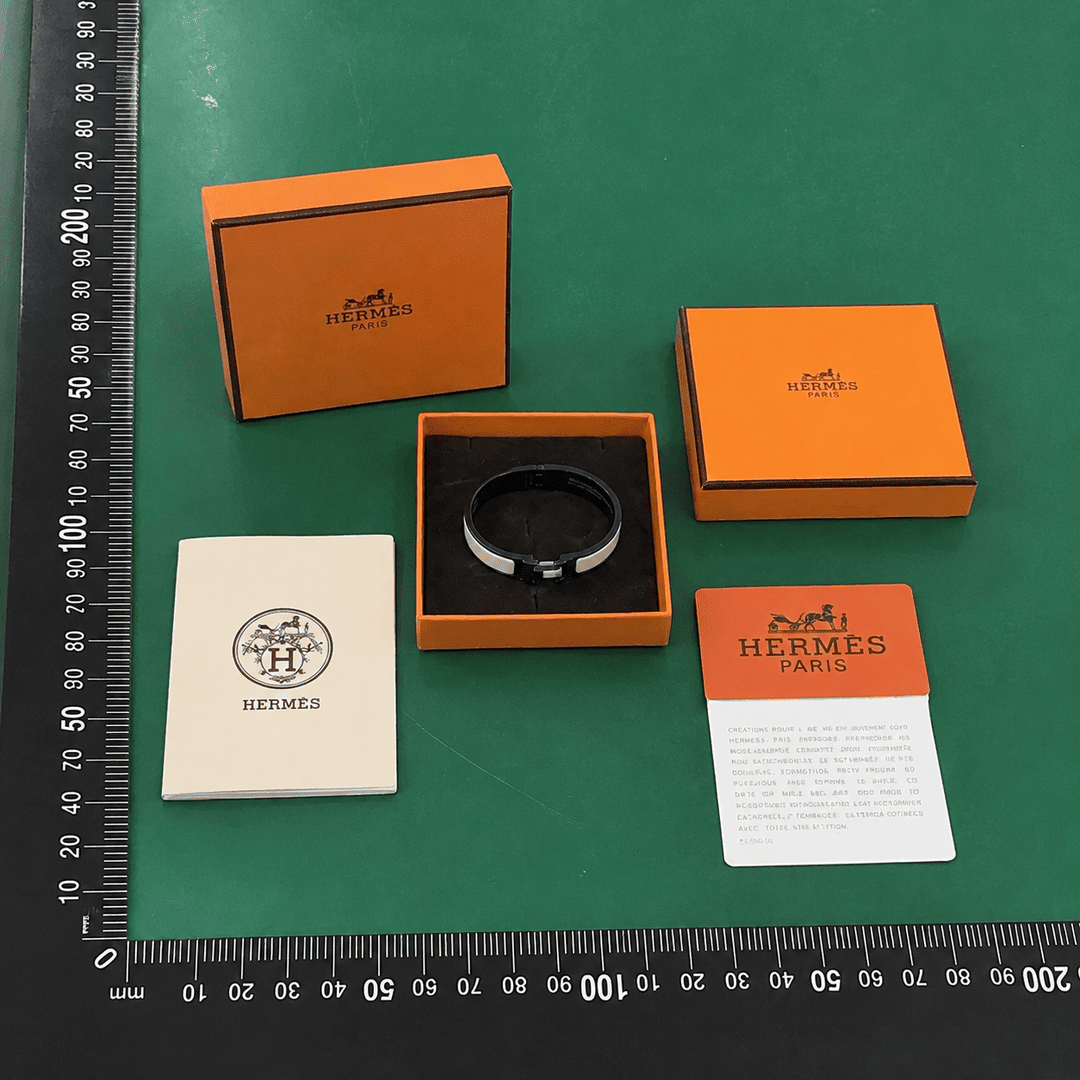
Caption: This image corresponds to the Hermès Matte Gray "H" Bracelet, used only as an example of evidence boundaries. It cannot support any judgment about the style, sizing, hardware, or authenticity of a Cartier bracelet.
Enter the Original QC Photos for That Item via View QC Photos
Once in the gallery, start with identity verification, not with looking for flaws. I suggest recording the following:
- Whether the QC photos show an overall silhouette and color consistent with the detail page.
- Whether the photos show multiple angles of the same item, rather than a collage of different items.
- Whether you can see the clasp, connection points, inside surface, and any size reference.
- Whether the photos are clear enough to judge scratches, oxidation, or assembly deviations.
- Whether glare, shadows, compression, or obstructions affect your judgment.
If the target is a Cartier bracelet, the photos should at least allow you to identify the link structure, clasp structure, and size reference relevant to that style. The specified photos show an H-shaped bangle, so you cannot derive Cartier link count, clasp structure, or logo placement from them.
How to Record Link Arrangement, Surface Details, and Connection Points Item by Item
For QC photos that actually belong to the target Cartier bracelet, you can check three areas.
First, link arrangement. Observe whether adjacent links maintain consistent spacing, whether there is noticeable twisting at curves, and whether link joints show gaps or misalignment. Here you can only describe what you see in the photos; you cannot turn "looks neat" into "durable" or "quality workmanship."
Second, surface details. Record obvious dark spots, linear marks, color differences, and reflections separately. A bright white highlight in a single heavily reflective photo is not necessarily fading, and a dark area in shadow is not necessarily oxidation. When asking the seller for more photos, request lighting from different angles, with the same area visible in both close-up and overall shots.
Third, connection points. Connection points usually need closer photos than flat surfaces, because gaps, rough edges, misalignment, and looseness are easily hidden in overall shots. If there are no sharply focused photos of the connection points, your conclusion should be "insufficient evidence," not "no problem by default."🔍
What Clasp, Markings, and Size References Can Support
Clasp photos can help judge whether the structure matches the style shown on the detail page, and can reveal obvious gaps, misalignment, or surface damage. But they cannot prove brand authenticity on their own. Marking photos likewise can only show whether a certain visible mark appears in the image, not the source, material, or authorization status.
Sizing requires a measurement method. The page data indicates this Hermès bangle is listed as 17–19 cm, but it does not state whether that number refers to wrist circumference, inner circumference, or another measurement. The data also mentions that Clic H-type bangles have PM and GM size distinctions, and an 18 cm wrist may be on the tight or borderline side. This information is a general size reference, not size evidence for the Cartier in the current photos, and cannot replace an actual measurement by the seller for the target item.
You can ask the seller to provide:
- A clear measurement photo of the bracelet or bangle's inner circumference.
- A photo where both the start and end points of the ruler are in frame.
- One photo in the clasped state and one in the naturally open state.
- An explanation consistent with your own wrist measurement method.
| QC evidence | What it can support | What it cannot support |
|---|---|---|
| Overall photo | Whether color, silhouette, and general structure match the detail page | Authenticity, long-term durability |
| Clasp close-up | Whether there is obvious misalignment, gaps, or surface damage | Brand authorization or material guarantee |
| Measurement photo | The measurement value and method the seller used | Absolute guarantee of wearing comfort |
| Multi-angle detail photos | Some visible scratches, oxidation, or assembly issues | That areas not shown in photos are problem-free |
How to Distinguish Scratches, Oxidation, Assembly Deviations, and Photo Glare
Scratches usually appear as directional linear marks that stay roughly in place when the light angle changes; oxidation or color differences are more likely to appear as regional changes, but a single compressed photo cannot determine the cause. Assembly deviations should be judged by looking at symmetry, seams, and connection positions; do not treat shadow edges as structural misalignment.
Glare is the easiest thing to misinterpret. If bright spots move with the camera angle and have smooth transitions, they may just be light reflections; if the same linear mark appears in the same spot across multiple photos from different angles, then you should request more photos or an explanation. Do not ask the seller to hide problems with editing, and do not treat AI-generated images as real QC evidence.🧾
QC Visible Evidence Cannot Prove Authenticity or Overall Quality
QC photos can help spot some appearance and assembly risks, but they are not an authentication report, and cannot prove Cartier identity, precious metal content, gemstone grade, production batch, or long-term wear performance. The specified photos even correspond to a different brand, so you especially cannot transfer the H-shaped structure, color, or size information to a Cartier bracelet.
A safer approach is to separate your conclusions into three layers:
- Seen: colors, structures, scratches, or measurement readings that are clearly identifiable in the photos.
- Inferred: limited editorial judgments based on angle, lighting, and structure.
- Unverified: authenticity, material, durability, areas not shown, and future after-sales results.
In your order notes or communication records, save the product name, variant, photo number, issues found, and seller replies. Do not publicly share full order numbers, payment cards, passports, addresses, or complete shipping labels.🛡️
Requests for More Photos, Pausing, and Next Steps When Evidence Is Missing
If you actually intend to buy a Cartier bracelet and the page still provides Hermès photos, pause confirmation and ask the seller or platform for original QC photos belonging to that Cartier item. Your request should be specific about the area and purpose, for example: please provide front and back of the full link chain, clasp closed and open, close-up of any markings, close-up of connection points, and a photo measuring the inner circumference with a ruler.
After receiving the additional photos, re-check whether the style, color, and structure in the photos match the detail page variant. If you still cannot confirm the photos belong to the item, or the measurement method is unclear, do not approve based solely on low price or page copy.🚫
In this example, continuing to use the existing photos only saves time in finding alternative reference images, but it increases the risk of misapplying evidence from another brand to a Cartier judgment. This is suitable for those who need to learn QC reading methods and understand evidence boundaries; it is not suitable for those who need to confirm Cartier authenticity, material, size fit, or overall quality. For the latter, only when the target item's detail page matches its corresponding View QC Photos gallery, and key angles and measurement evidence are complete, is it worth moving to the next step.
Article Images
