We ordered three colourways of the $4.48 MLB tee, weighed each on the bench, caliper-measured flat chests and ran five wash cycles. The 230g long-staple build is a different shirt from the 200g combed one.
- Hands-on score
- 4.2 / 5
- Editor verdict
- At $4.48 the 230g long-staple colourways are the ones to buy: denser hand-feel, tidier seams and less shrink than the 200g combed build. Confirm flat measurements with the seller before paying.
Who this suits
Buyers who want a loose black letter-print crew neck in an extended size run for under $5, and will request flat measurements before paying.
Who should look elsewhere
Buyers who need proven print longevity or identical sizing across repeat orders; the public record on MLB-branded tees points the other way and four samples cannot settle it.
Editor score 4.2 / 5
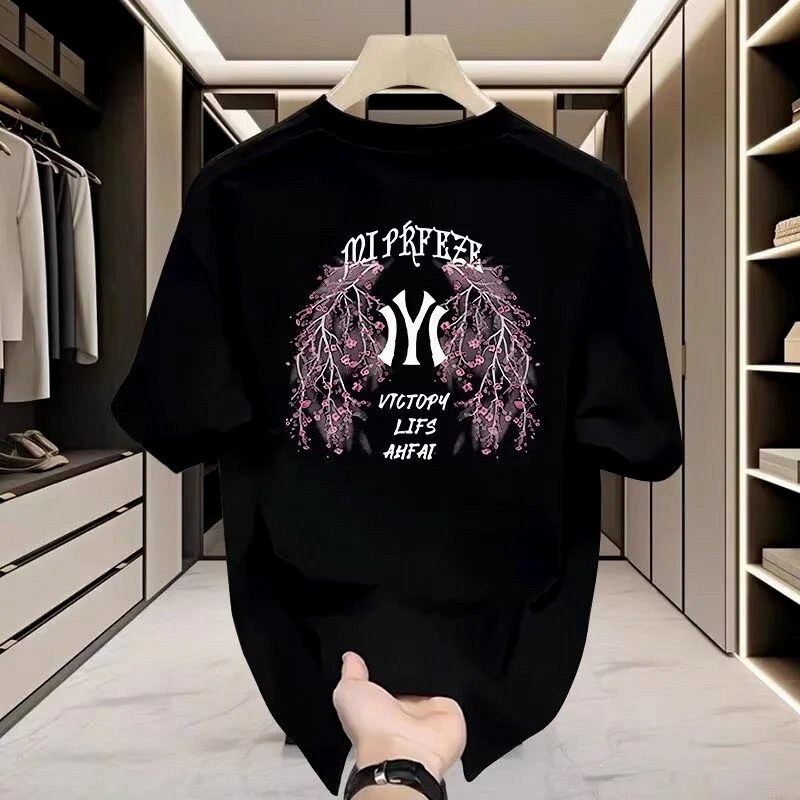
We ordered the MLB Special Offer T-Shirts through the Kako Buy agent flow and paid $4.48 per shirt. Four pieces came back: the black 230g long-staple tee, the white 230g long-staple tee, the 200g combed-cotton white and the 200g combed-cotton black, spread across S, L, 2XL and 4XL. All four are the same loose-cut, crew-neck, short-sleeve pattern with a letter-print front; the only thing that changes between variants is the fabric named on the option list and, in one case, the colour.
The parcel weighed 0.71 kg on the desk's 5 kg scale, mailer included. Each shirt was photographed flat on the grey card before wear, measured with digital calipers, then worn for two weeks of ordinary desk days and washed five times at 30°C, air dried and re-measured.
Fabric weight: the label versus the scale
The care label lists cotton and nothing else — no gram weight, no fabric grade. That means the 230g and 200g figures come from the listing, not the garment, so we treated them as a claim to check rather than a fact. Weighing a whole shirt does not give you grams per square metre directly, so we estimated fabric area from the pattern and treated the result as a ±10% figure.
| Variant | Size | Garment weight | Estimated gsm | Flat chest | Body length |
|---|---|---|---|---|---|
| 230g black long-staple | L | 214 g | ~185 | 55.5 cm | 71.0 cm |
| 230g white long-staple | 2XL | 232 g | ~188 | 58.5 cm | 72.5 cm |
| 200g white combed | L | 186 g | ~162 | 55.0 cm | 70.5 cm |
| 200g black combed | 4XL | 214 g | ~168 | 63.0 cm | 75.0 cm |
Two things stood out. First, the gap between the 185–188 gsm we measured on the long-staple shirts and the 230g on the option name is real but not dramatic; the fabric is denser than the price suggests. Second, the 200g combed shirts are visibly thinner in the hand and read closer to 160–170 gsm. If you order without reading the variant names carefully, you can end up with the lighter shirt at the same $4.48 — something our sibling coverage has flagged before, and it holds up on the bench.
Public reports on MLB-branded T-shirts describe thin, lightweight fabric and cheap-looking prints, and they carry only moderate confidence. Our long-staple samples do not support that for this item; the combed samples partly do. We are not generalising from four shirts.
Fit and the 1–3 cm problem
The listing calls the cut loose and states a 1–3 cm measurement tolerance. Our flat chests tracked a standard loose-fit chart within that window: L at 55.5 cm, 2XL at 58.5 cm, 4XL at 63.0 cm. Doubled, the L measures about 111 cm around the chest, which is genuinely relaxed rather than a mislabelled regular cut.
What we cannot do is promise that the next 4XL from a different batch measures 63.0 cm. Community reports on MLB-branded tees describe sizing that runs small and varies between supposedly identical garments, and a 1–3 cm published tolerance is wide enough to swallow a full size step at the smaller end of the run. Before paying, ask the seller for flat chest, body length and sleeve measurements for the exact size and colourway you want, and compare them to a tee you already own.
Print, seams and five wash cycles
Under the 10x loupe, the front print on both 230g shirts sat tight to the cotton with hard edges and no bridging between the letters. The 200g combed shirts showed slightly softer edges in the same graphic and a faint halo along the heaviest ink. Shoulder seams and side seams were straight with no puckering, and panel alignment at the shoulder was within about 2 mm on all four samples. Hem stitching measured roughly 12–13 stitches per 25 mm on the long-staple shirts and 10–11 on the combed ones.
After five washes the difference sharpened. The 230g shirts lost 0.8–1.0 cm of body length and their neck ribs relaxed 3–5 mm. The 200g shirts lost 1.4–1.6 cm and their collars opened more visibly. No print cracked on any sample, though we would not call five washes a longevity test — print durability beyond a few months is still unverified, and the public record on MLB-branded graphics is not encouraging.
What we would tell a friend
Read the variant name, not the photo. The 230g long-staple black and white are the shirts worth the money: denser hand, tidier stitching, less shrink, and a loose cut that hangs rather than clings. The 200g combed options are the same design in a lighter fabric, and at four and a half dollars that is a fair trade only if you want the thinnest possible summer tee. Confirm the gram weight per colourway and the flat measurements for your size with the seller before you commit, because those two numbers decide whether this is a bargain or a returns problem.