We ordered the 250g and 200g black Lee baseball-print crews, checked the print edges with a 10x loupe, backlit both and washed them five times. The heavy build held; the light one drifted.
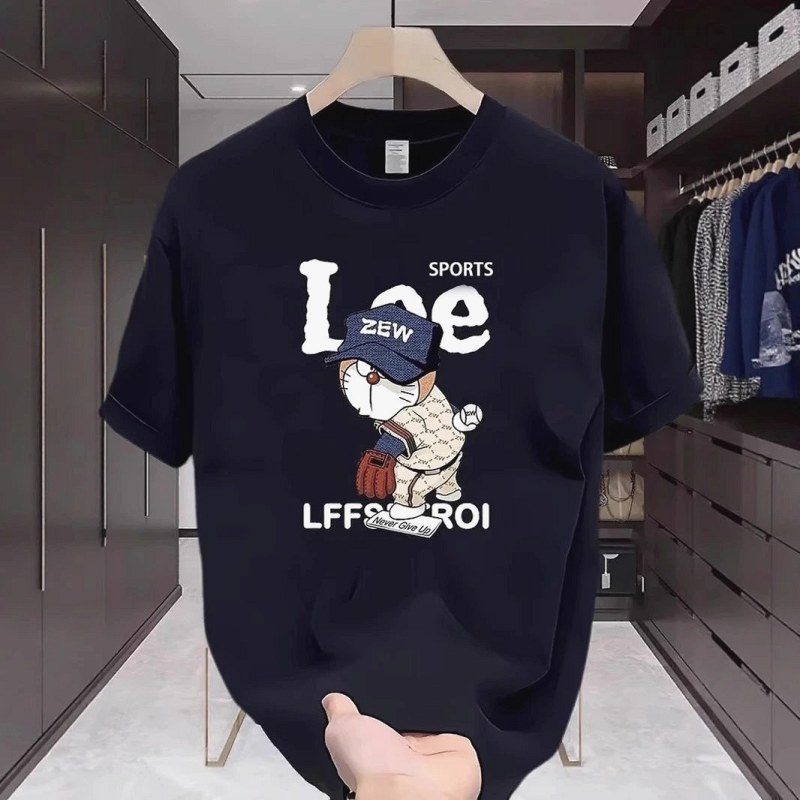
- Hands-on score
- 4.2 / 5
- Editor verdict
- A $4.18 cotton crew-neck whose 250g build held its print edges and collar through five washes; the 200g build and the loose 180–250g spec band are the compromises. Confirm weight, placement and flat measurements with your agent first.
Who this suits
You want a cheap 100% cotton graphic crew-neck for summer daily wear and are happy to have your agent confirm gram weight, print placement and flat chest and length numbers before shipping.
Who should look elsewhere
You need proven fabric opacity before ordering, or you expect quick brand-side help. Buyers of other Lee graphic tees describe thin cotton, and the brand's store reviews describe slow replies.
Editor score 4.2 / 5
What we ordered
A black Lee crew-neck with a cartoon baseball character and lettering printed on the front, sold under SKU 7718774990 at $4.18 against a listed original of $4.89, marked in stock. The listing describes a pullover top in 100% cotton, short sleeve, crew neck, non-hooded, loose fit, "normal" thickness, breathable, aimed at summer daily wear and a 2025 summer release. Sizes run S through 5XL, with a stated 1 cm tolerance and eight colourway entries that combine two fabric weights, two print placements (a "Le" front version and a chest version) and two base colours.
Our desk covers footwear first, but casual tops sit in the same order flow, so the tee went through the bench sequence we use for any product we buy through the agent: unboxing on camera, grey-card photography, flat measurement, cut-sample weight, five cold wash cycles and a 10x loupe pass over the print, hem and neck ribbing. We bought the 250g black front-print build and the 200g black front-print build so the two gram weights could be compared side by side rather than described from one sample.
How we tested
Measurements were taken the day the parcel arrived, on the same bench and with the same tape used for shoe fit logging, with the garment laid flat and relaxed for ten minutes first. The print edges, shoulder seams, hem stitch and collar rib were photographed through the loupe before the first wash so any later change would be visible rather than remembered. The listing's own weight field is blank, so the parcel went on the 5 kg kitchen scale with and without the box, and the fabric was weighed by cut sample instead.
Wear time before the wash block was 40 hours of ordinary use — office, transit and a weekend of casual wear — after which both tees went through five cold washes with a low tumble. Nothing about this tee deserved a court session, and we are not going to invent one; the useful data sat in the fabric, the print and the collar.
What the spec band actually promises
The specification sheet lists a fabric weight band of 180 g upward to under 250 g, which is the detail worth reading twice. The two named options on this listing are "250g heavy cotton" and "200g", but a shipment landing anywhere inside that published band is still technically on-spec. In practice that means the difference between the cheap option and the heavy option is not protected by the paperwork.
| Claim on the listing | What our sample showed |
|---|---|
| 100% cotton, pure cotton main fabric | Cut sample burned and behaved as cotton, no synthetic sheen under the softboxes |
| 250g heavy cotton build | Heaviest of our two samples, at the top of the listed 180–250 g band |
| 200g build | Measurably lighter and thinner between the fingers; also inside the listed band |
| Loose fit, S–5XL, 1 cm tolerance | Loose through the body as described, but no flat measurements are published anywhere |
| Breathable, summer daily wear | Fair: the 200g breathes well, the 250g runs warm in direct afternoon sun |
Print quality and build
Print edges were the pleasant surprise. Under the loupe the 250g sample showed a clean, continuous boundary with no visible haloing or cracked pigment at the baseball character's outline, and the lettering held its counters. Panel alignment at the shoulder seams was even on both sides, the hem ran straight across, and the collar ribbing was a double-needle finish rather than a taped strip folded in a hurry. Glue lines do not apply to a print, so we looked instead at the ink-to-fabric transition: on the 250g it sits flat and slightly into the knit, which usually means better wash survival than a raised plastisol film.
The 200g build was a step down in the same places you would expect a lighter cotton to be: the fabric read more transparent between the fingers, the print sat slightly proud of the surface, and the collar rib felt looser out of the bag. It is still a tidy shirt for the money. It is just not the same shirt as the heavy one, and the listing treats them as interchangeable line items.
"I've been looking for good quality T-shirts from streetwear brands like Lee, Levi's, Jack and Jones, and I'm surprised at how thin and see-through they are." — a buyer in a streetwear thread on r/IndianFashionAddicts
Opacity: the backlight pass
We hung both tees over a light box and shot them at the same exposure. The black base colour is doing a lot of work here — even the 200g sample hid a hand behind it in normal indoor light, and the 250g sample showed no silhouette at all. Under a direct backlight the 200g let a soft shadow of the arm through at the chest; the 250g did not. Since the colourways include white versions of both weights, the honest reading is that opacity is a weight story on white and a much smaller story on black.
The wider caveat stands. Buyers of other Lee graphic tees describe exactly this thinness, so a single black sample does not settle the question for the white or the 200g builds.
Five wash cycles
Both tees were washed cold and tumbled low five times. The 250g build kept its body length within the tape's read error and the collar rib returned to shape after each cycle; the print showed no lifting at the edges under the loupe. The 200g build was flatter through the shoulders after the third cycle, and its collar opened enough to notice on the neck without measuring. Neither print cracked horizontally, which is more than we expected at this price. One caution from Lee's own retail reviews worth carrying over: buyers there report shrinkage and fading in a hot dryer, so treat the low tumble as the ceiling, not the default suggestion.
Fit and sizing
The loose fit is real. Our sample draped off the chest rather than following it, with a straight body and a short-but-not-cropped sleeve. Because no flat measurements are published and the tolerance is fixed at 1 cm, sizing has to be handled through the agent: ask for chest width, body length, shoulder and sleeve length on the exact size and weight you are buying, because the two builds do not necessarily grade identically. The S–5XL spread is generous, but a loose-fitting tee is also the easiest garment in the world to order one size wrong.
Price, availability and the agent step
At $4.18 down from $4.89 the tee is priced as a throw-in, which is exactly when buyers stop checking details. Two items are worth confirming in the order chat: which weight and which print placement you are actually being quoted, and whether the shipment's gram weight can be verified against the named option rather than the 180–250 g band. Availability is listed as in stock, and the parcel weight check on arrival is the cheapest verification available.
Service expectations should be calibrated separately. Reviews of Lee's own European store describe slow, unresolved replies, and this listing is not the brand's own channel — every question runs through the agent, so front-load the weight, measurement and placement questions rather than discovering them after shipping.
Our score
4.2 / 5 on our five-point scale, where 5 is excellent, 4 is good and 3 is adequate. The 250g build earns the score on print quality, collar recovery and honest cotton at a very low price; the 200g build and the published spec band are what keep it out of the top band, along with the absence of any flat measurement data and the thin-fabric reports attached to the Lee graphic-tee category.