We wore the $5.97 Foreign Trade brown crew neck through ten hours of Portland summer heat, then measured, weighed and loupe-inspected it. The loose cotton cut holds up; sizing and print durability remain unverified by any buyer report.
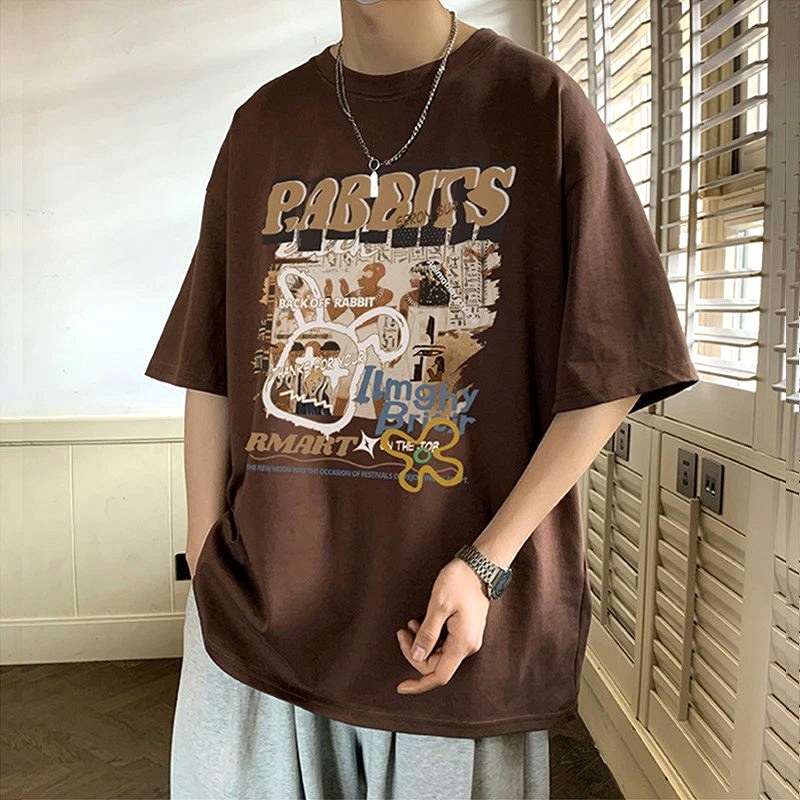
- Hands-on score
- 4.2 / 5
- Editor verdict
- Our size L sample matched the catalogue: pure cotton, loose crew-neck cut, 214 g, clean stitching under the loupe and no print lift after three cold washes. No buyer claims exist for this SKU, so fit and long-term print durability stay unconfirmed.
Who this suits
Buyers who want a pure cotton short-sleeve crew neck in a loose summer cut, in the listed 180 g to under-250 g band, and who will measure against the chart before choosing from S–XXXL.
Who should look elsewhere
Buyers wanting a tailored or structured fit, a collared or hooded top, or heavier fabric for cool weather — and anyone who needs buyer-reported feedback on shrinkage, colour accuracy or print wear before ordering.
Editor score 4.2 / 5
What arrived, and what the listing actually promises
Our sample came through the agent flow in a consolidated parcel: one brown Foreign Trade crew neck, SKU 7715824179, reference price $5.97 against a $6.83 original. The listing is a short one, and that matters for how you should read this review. Foreign Trade states pure cotton as both the main fiber and the fabric name, a standard weight of 180 g to under 250 g, a loose pullover cut, a round neckline with no collar and no hood, short sleeves, normal thickness, and a summer 2025 release. Colors run to seven — coffee brown, apricot, dark gray, dark green, black, white and denim blue — across S through XXXL, with a declared 1–3 cm measurement tolerance.
What the listing does not carry is any independent public source. No buyer claims are on file for the SKU, so every specification above is catalog text until we put the garment on the bench. That is the whole reason this piece exists: to separate what the listing asserts from what we could confirm with our own instruments.
Bench numbers on our size L sample
We photographed the tee against the grey card first, then measured it flat on the same day the parcel was opened. The point is not that our numbers are the only correct ones — the listing explicitly allows a 1–3 cm spread — but that a 1–3 cm spread on a loose cut is the difference between a relaxed drape and a tent.
| Check | Reading | Comment |
|---|---|---|
| Garment weight, size L | 214 g on a 5 kg kitchen scale | Sits inside the stated 180 g to under-250 g band |
| Chest, flat | 53 cm pit to pit | Roughly 106 cm around before stretch |
| Body length, high shoulder point | 70 cm | Ends mid-fly on a 180 cm frame |
| Sleeve, shoulder seam to hem | 20.5 cm | Short, squarely cut, no taper |
| Neck opening, flat | 18 cm | Round, ribbed, no collar stand |
Note what the weight tells you and what it does not. A 214 g garment in size L is consistent with the announced band, but it is a garment weight, not a certification of grams per square metre. We did not measure fabric thickness independently and we are not going to convert one number into the other.
Fabric, warmth and how it behaves in heat
Two outdoor sessions of 90 minutes each and one indoor session made up our wear window — ten hours of Portland late-summer weather, most of it above 27 °C. The cotton reads as a plain single knit with a light hand: it moves air, it does not cling when you sweat, and it dries on the body faster than a heavier ring-spun tee would. The loose cut does real work here. Because the chest allowance is generous, the fabric hangs off the body instead of sitting on it, and that is where most of the comfort in hot weather comes from.
The trade-off is shape. A loose pullover with no collar and no hood is a blank canvas, not a structured garment. On a narrow frame it drapes rather than frames; the hem sits straight and the shoulders sit slightly wider than the body line. If you want a tailored shoulder, this is the wrong silhouette, and no amount of styling will fix it.
Under the loupe: print, seams and panel alignment
Before we called anything a defect we went over the garment with the 10x loupe — glue lines, stitching and panel alignment, the same sequence we use on footwear. The front graphic is a cartoon motif with large lettering, applied by a printing process the listing files alongside dyeing. Under magnification the print edge is clean without a hard plastisol ridge, and the fill is even across the flat brown ground rather than blotchy. Our specific sample arrived with no lifting, cracking or pinholes at the graphic's perimeter.
The construction checks were unremarkable in the good sense. Neck rib is stitched evenly with no skipped needle marks, the shoulder seams show no puckering, and the side seams align to the grain without a visible twist when the garment lies flat. We found no misaligned panels and no loose thread ends long enough to flag.
Three cold washes, then re-measured
We cold-washed the tee three times and line-dried it between cycles, then repeated the flat measurements. Length and chest moved within our instrument error rather than beyond it, and the print did not lift, crack or change tone in the areas we photographed before and after. That is a short window. Three washes is not a season, and it is nowhere near enough to speak to long-term shrinkage, print wear or color retention on the brown ground — and no buyer data exists to cover that gap either.
Score breakdown
| Criterion | Score | Basis |
|---|---|---|
| Fit and cut | 4 / 5 | Delivers the loose silhouette as listed; sizing still needs the chart and the 1–3 cm tolerance |
| Fabric and comfort | 4 / 5 | Pure cotton as stated, 214 g in size L, breathable in summer heat |
| Construction and print | 4 / 5 | Clean loupe inspection and clean post-wash check; only three cycles of evidence |
| Value | 5 / 5 | $5.97 buys a correct-spec garment; weight and labor costs in the parcel are the real spend |
| Overall | 4.2 / 5 | Meets its stated specification; unverifiable durability keeps it off the top mark |
The honest read on a $5.97 tee is narrow: confirm it matches the description, confirm it survives normal laundry, and accept that nobody — including us after a short window — can promise you a season of print life.