Our hands-on look at the Casablanca graphic print tee: 250 g cotton, a relaxed crewneck cut and dozens of numbered black and white variants. Weight and print hold up; sizing and variant artwork need confirming first.
- Hands-on score
- 4.0 / 5
- Editor verdict
- A 250 g pure cotton crewneck with a dense, well-registered front print and a relaxed cut that suits warm-weather streetwear. Order only after matching your variant number to its artwork and comparing the measurement chart to a tee you own.
Who this suits
Buyers who want a heavyweight, generously cut graphic tee for summer casual wear, are comfortable reading a measurement chart and will confirm which numbered artwork they are paying for.
Who should look elsewhere
Buyers who need a slim tailored fit, want a single verified answer on sizing, or rely on documented after-sales support from the seller.
Editor score 4.0 / 5
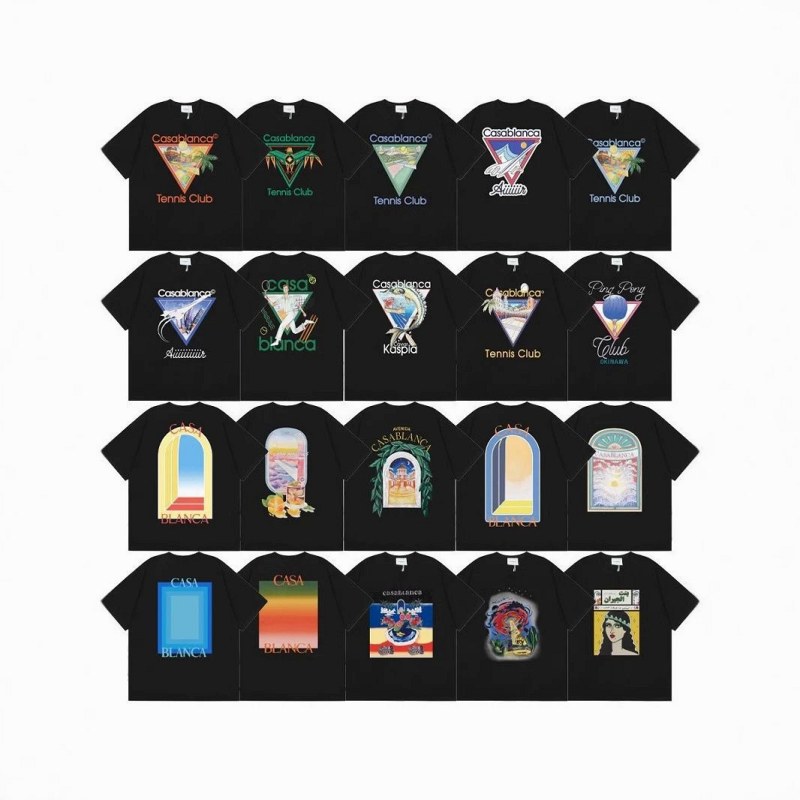
The Casablanca graphic print black T-shirt is a crewneck pullover listed at 250 g in pure cotton, cut relaxed, printed across the chest and sold in a very long list of numbered black and white variants. At $8.81 (down from $9.27) against a genuine Casablanca tee that retails between roughly $280 and $325, the interesting question is not whether it is the same garment — it plainly is not — but whether the cotton weight and print execution make it a sensible warm-weather layer on their own terms. We ordered a pair of variants through the agent flow and put one on the bench and on our backs.
What arrived and how we tested it
The parcel came in at a normal single-garment weight with no box heft to speak of, so we logged it on the 5 kg scale and moved straight to the bench. Our sequence for apparel is the same one we use for footwear, minus the wear route: photograph both sides on the grey card before handling, tape the chest, shoulder, sleeve and back length flat, then work the seams and print under the 10x loupe before anything goes in a washing machine.
From there the shirt went through a week of ordinary wear plus three cold washes inside out, hung flat to dry, with the print re-photographed after each cycle. Flat-lay and detail images are retained so any later claim about print loss can be checked against the day-one state.
Specifications as listed
| Specification | Listing detail |
|---|---|
| Brand | Casablanca |
| SKU | 7718753246 |
| Price | $8.81 USD, listed on sale from $9.27 |
| Availability | In stock |
| Fabric | Pure cotton, 250 g, print dye process |
| Style | Pullover, collarless crew neck, short raglan sleeve, no hood |
| Cut and thickness | Relaxed/loose, normal thickness, 1–3 cm stated tolerance |
| Sizes | S, M, L, XL |
| Colours | Numbered variants 37 through 90, each in black and white |
| Season | Listed as summer 2024 release, casual use |
Fabric and hand feel
Printed dye on pure cotton at 250 g is a genuinely useful weight for a graphic tee — heavy enough to hang off the shoulder instead of clinging, light enough that it still works in July. The listing does not claim organic cotton, and no country of manufacture appears anywhere on the page, which is a real difference from the genuine article: Casablanca's own tees are 100% organic cotton made in Portugal at roughly 220–240 g. Our sample felt a touch denser and drier than the softer combed hand of the retail shirt, a difference you notice against the skin more than in a photograph.
After three cold washes the body held its shape, the neckband survived without flaring, and the hem stayed level. Shrinkage was inside the stated 1–3 cm tolerance band, which is the correct way to read that number: it is a warning about measurement variance, not a fit guarantee.
The front print
The graphic is the whole point of the shirt, so we spent most of the bench time on it. Under the 10x loupe the ink edges on our sample were clean rather than feathered, the coverage was even across the geometric and cartoon-inspired motif, and we found no pinholes or skipped areas in the fill. That is consistent with the sourced buyer reports on Casablanca tops, which describe the brand's graphics as A+ quality and the cotton as thick.
Three cold washes inside out cost us some depth in the darkest ink but produced no cracking or lifting at the edges. Print durability across a full season is still an open question, and the buyer reports we have cover Casablanca shirts generally rather than this listing, so we are not treating it as settled.
Cut, sizing and the fit gamble
The catalog calls this a loose cut with a 1–3 cm tolerance. In practice it drapes with clear room through the body and the raglan shoulder sits low, which is exactly what casual streetwear styling wants: denim, shorts, or an open jacket with the graphic left visible. Nothing about the pattern is tailored or slim.
Where it gets awkward is the sizing conversation. Sourced buyer reports split down the middle — some readers suggest sizing down for a more tailored result, others report true to size — and Casablanca itself notes that its own T-shirt sizing changed from SS25, advising previous clients to size down. That is two different sources of confusion converging on one purchase. Our advice is unromantic: pull the chest and shoulder figures for the size you want, compare them with a tee that already fits you, and ignore the label.
The variant problem
The listing runs roughly fifty-four numbered colour codes, from 90 down to 37, each in black or white. Two shirts labelled "88 black" and "88 white" are the only names buyers get; the artwork itself is carried entirely by photographs. If you order without matching the code to its image, you are buying a design you have not seen. This is the single most common way an order like this goes wrong, and it costs nothing to prevent.
Value and what to watch
Judged purely as a heavyweight printed cotton tee at under nine dollars, this is a strong proposition: the weight is above the entry-level 160–180 g norm, the print survives laundering on our sample, and the relaxed cut is forgiving. Judged as a Casablanca purchase, the gaps are the ones you would expect — no organic certification, no stated origin, and no documentation of after-sales support.
That last point deserves a straight sentence rather than a scare story. One retail buyer has publicly reported a defect after minimal use and a refused replacement. It is a single report and it concerns a different sales channel, so we are not treating it as a pattern. We are treating it as a reason to avoid a fit that relies on stretch or a size you cannot exchange.