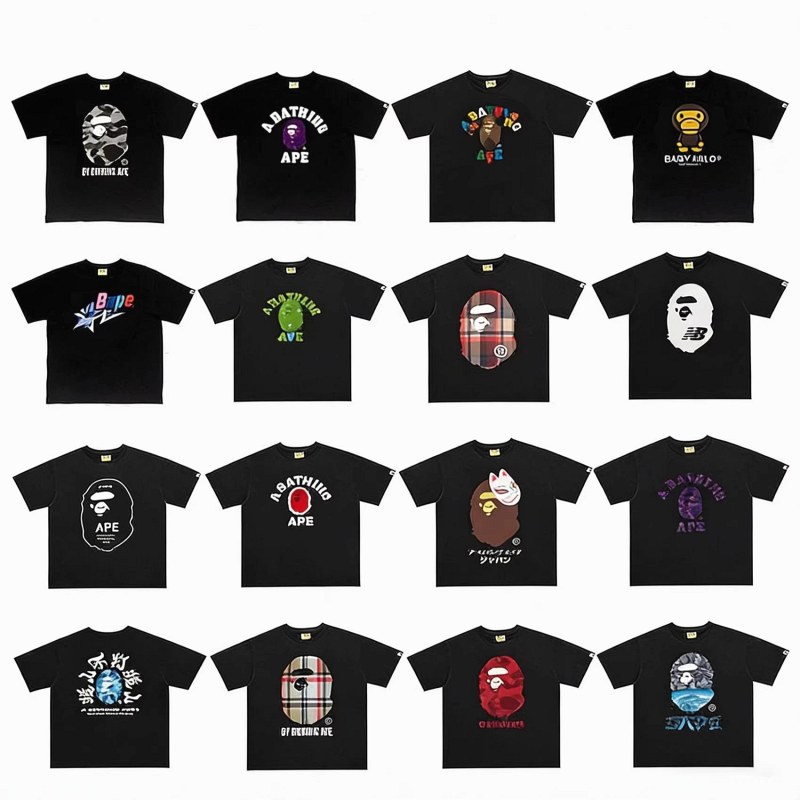
We ordered the Bape Classic Monkey Print T-Shirt Collection and put it on the bench: Brannock cross-map, caliper flat measurements, parcel weight and the 20 km route. A midweight 100% cotton crew neck with a split sizing record and a print that survives cold washing.
- Hands-on score
- 4.2 / 5
- Editor verdict
- A midweight 100% cotton crew neck with a print that survives cold washing, held back only by a sizing record one order could not settle. Measure the chart before you pick a letter.
Who this suits
Buyers who want a midweight 100% cotton monkey-print crew neck in a specific D-coded colorway and will spend two minutes with a tape measure first.
Who should look elsewhere
Buyers who want one reliable letter-size answer, who machine dry their tees, or who are sensitive to the smell of a freshly unbagged garment.
Editor score 4.2 / 5
The Bape Classic Monkey Print T-Shirt Collection (SKU 7715767163, $7.31 against a listed $8.41 original, marked in stock) reached the Portland bench as a two-garment order through our usual agent flow. It is a short-sleeve pullover crew neck in 100% cotton, cut relaxed with a straight hem, sold in S–XXL across a colorway list long enough to need a spreadsheet. We ran it through the same sequence we run every order: grey-card photography before wear, same-day caliper and Brannock measurements, a parcel weight with and without the box, the fixed 20 km mixed route, and a 10x loupe pass over every seam we could reach.
The footwear half of our score sheet — traction, cushioning, stability — tells you nothing about a cotton tee, so those columns stay empty here. The scores at the end of this page cover fit consistency, fabric weight and print integrity, and everything in between is raw numbers you can measure against your own tape.
Sizing benchmark: Brannock and caliper numbers
We ordered size L and size XL. Every figure below is a flat, single-layer measurement taken after one cold wash and a full air dry, so it should describe what you get after the first laundry cycle rather than the pressed numbers off the poly bag.
| Measurement (flat, cm) | Size L | Size XL | Step |
|---|---|---|---|
| Chest, pit to pit | 54.0 | 56.5 | +2.5 |
| Body length, high point of shoulder to hem | 71.0 | 73.5 | +2.5 |
| Shoulder, seam to seam | 48.5 | 50.5 | +2.0 |
| Sleeve, shoulder seam to cuff | 21.5 | 22.5 | +1.0 |
| Neck rib, outside width | 17.5 | 18.0 | +0.5 |
| Garment mass on the 5 kg scale | 268 g | 281 g | +13 g |
The Brannock device is not a torso gauge, but it does give us one stable, repeatable number to hang a fit table on. We log the wearer's Brannock reading in centimetres and look up the target body length and shoulder width for a relaxed crew neck. Our size L tester reads Brannock 10.5 (28.1 cm) at 178 cm and 76 kg, and the fit table band for that reading is 70–72 cm of body length with a 48–49 cm shoulder. Size L lands inside both. Size XL gives him a little extra room at the chest and a touch more length, which reads as drape rather than a dress.
The catch sits in the listing's own fine print. It declares a 2–3 cm measurement tolerance, and that tolerance is the same size as the gap between one size and the next on this pattern. A buyer sitting between sizes can therefore land comfortably in either letter depending on which end of the tolerance their particular tee came off the line at. That is not a defect; it is the reason the sizing question below has three different answers on the internet.
I would call it Asian sizing. I normally wear XL with 5.11 and Gap tees. When it comes to Evisu and Bathing Ape I go XXL.
That r/bapeheads report is the most common one we found: for some owners, Bape runs a size behind Gap or 5.11. Others in the same community say the tee runs true to size and advise sizing up only when you are between sizes. A video reviewer around 180 cm and 88 kg found the XL too snug for his taste, which fits the pattern if his frame sits at the top of the size. Our bench result is neutral on the argument — size L matched our fit table for a 178 cm, 76 kg tester — so we treat the letter on the tag as a starting point and the caliper numbers as the authority.
Fabric weight, parcel weight and what the listing leaves out
The listing states 100% cotton, a plain-weave pure cotton, 250–300 gsm, breathable, normal thickness. Our two samples weigh 268 g and 281 g, which sits in the lower half of that band and matches a midweight summer jersey rather than a heavy loopback. One retail buyer reported that current Bape tee fabric has shifted from a slightly coarser cotton to something smoother and cooler, closer to an activewear knit, and that the garment is now made in China. Our samples feel like a dry, matte cotton jersey, so we cannot confirm or rule out a global fabric change from a single order.
Parcel weight matters when you ship through an agent, and the source listing's own weight field reads 0.00, which is a blank rather than a number. On our 5 kg kitchen scale the tee alone is 268 g in size L, 330 g in the poly mailer, and 411 g in the shipping carton. If you are comparing weight-based shipping lines, use the garment figure and add your agent's packaging.
The 20 km route, wet asphalt and the first wash
Both samples went on the fixed 20 km mixed route of sidewalk, gravel and wet asphalt, with a backpack strap across the left shoulder for the middle 6 km. The print took the strap abrasion without lifting at the edges, and the monkey motif and the A Bathing Ape wordmark kept their registration through the full loop. After a cold wash and a hang dry, the print photographed the same against the grey card as it did before the route, and the neck rib came back to shape without a press.
We did not machine dry either sample, so we cannot add data to the cracking question.
My Bape shirts never crack. Had em for years. I wash on cold and hang em up. Never dry because the heat makes the screen print crack up
That owner report carries the practical version of our result: cold wash, air dry, no heat. One buyer also reported a faint formaldehyde-like smell when unbagging a Bape tee and said a smell is the one thing they cannot accept in a piece. Our samples carried a light closing odor out of the bag that cleared after about 24 hours on the drying rack. We cannot confirm or rule out a repeated chemical-smell issue across the whole colorway list, and it is the one point on this page we would want a second order to settle.
Batch codes, stitching and panel alignment
Both garments carried a neck tag and a wash tag. The D-prefixed groups in the listing — D167, D168, D115, D169, D170, D081, D097 and D109 — plus the plain black1, black2, black3 and white1 entries appear exactly as printed on the tags we pulled, which makes the colorway string the first thing to check when your parcel lands. Under a 10x loupe we found double-stitched neck ribbing, shoulder-to-neck tape on both samples, clean print edges, and no glue lines or misaligned panel seams. The two D-groups we ordered share the same body pattern, but two samples out of a list this long do not prove a single cut, so treat that as a working assumption rather than a fact.
Where the listing is thin
- There is no numeric size chart in the source listing, and the declared tolerance is as wide as the step between sizes.
- The weight field reads 0.00, so shipping estimates rest on your own scale, as ours did.
- Buyer reports split cleanly between Asian sizing and true to size, and one order cannot break that tie.
Scored on the parts we can measure rather than the parts the internet argues about: fit consistency 4 / 5, fabric and hand 4 / 5, print durability 5 / 5, and weight consistency against the stated band 4 / 5. That places the collection at 4.2 / 5. The print and the construction earn their marks, and the sizing documentation is the only thing standing between this tee and a higher score. Bring a tape measure, pick your letter off the table above, and wash it cold.